| Chapter One | Chapter Two | Chapter Three | Chapter Four | Chapter Five | Chapter Six | References and Copying Rights |
Summary of Chapter Six
|
|
Before the meeting,do the up-front work.
"Growing" is not the same thing as "building"
|
QUICK READ
|
DETAILS
Start the meeting before the meeting. In other words, plan out the meeting ahead of time.
Planning means more than simply saying, "Let's meet next week." Planning means that
agendas are determined, issues are reviewed prior to meetings, appropriate data is made
available, and appropriate guests are invited.
A key rule about meetings should be, "Don't waste people's time." That means that those
things that can be done outside the meeting should be completed ahead of time. If necessary
homework has not been completed, then reschedule the meeting.
Planning can do more than this. If a proposed topic is going to create conflict between two
or three people, but not the whole team, then attempt to resolve differences before the team
as a whole meets. This will save embarrassment and time for everyone else.
The team leader is responsible for this up-front planning with assistance from the facilitator
as needed.
The agenda for the meeting ideally should have times allocated. When time limits are
reached, the facilitator should check with the group to see if it wants to continue talking, or
to move on.
Agendas are the outlines for meetings. In general, there are three parts to an agenda: (1)
looking backward, (2) work, and (3) looking forward.
Looking backward reviews the minutes of the previous meeting and puts the current meeting
into context. For instance, the team might be following a four step process for dealing with
an issue such as Before getting started, the team should agree where they are at in terms of that process.
The working portion of the meeting is for discussions and decision making. This might
include getting input from experts, brainstorming, sharing information, or whatever.
The looking forward part of the meeting is for reprioritizing, assigning homework, setting
the agenda for the next meeting, and continuous improvement.
|
|
SAMPLE AGENDA LOOKING BACKWARD 1. Group revises/approves agenda by consensus. This in effect makes it so that anyone on
the team could veto the agenda. It will be common for team members to want to change an
agenda at the last minute either because new issues have arisen or because the team leader
forgot to include something on the proposed agenda. The team should discuss the merits of
adding to the agenda versus delaying the item.
2. Warm-up. (Optional) Each person states in a sentence or two their overall emotional state.
For instance: "I'm distracted because of my work backlog," "I'm enthusiastic and ready to go,"
or "I'm fighting off the flu."
3. Revise/approve minutes from last meeting. Some teams will have someone summarize
verbally the minutes in order to remind everyone about the discussions that were ended in the
last meeting. These summaries are especially useful when they describe the process the team
is following and the team's progress in that process. (For example: last meeting we
brainstormed ideas. Today we will pick the best of those ideas.)
WORK
4. Announcements and Operations issues.Announcements can be by supervisors, team members, or by members of other teams. It is best that these be in writing. The facilitator
would then give team members a chance to read the announcements and then ask if anyone
has any questions.
In general, reading announcements out loud is a waste of time. People don't remember them
well and are better off having something in writing to take back to their work sites.
Unless the person making an announcement has requested input or reaction, the facilitator
should limit discussion to understanding the announcement and not debate over its merits.
Operations issues include vacation and meeting schedules and other ongoing operating
problems for the team. For quality circles and self-managed teams, operations issues might
be the most important part of the meeting. For cross-functional project teams, operations
issues will typically be minor. |
|
5. Projects (new and continuing.)
When writing the agenda, be specific about which projects are being discussed, and what
kinds of work will be taken at this meeting.
For instance, someone may be reporting back the results of research. Or someone else might
be bringing a flow chart of how a process works which the team will then revise.
If the team is at the stage of brainstorming, picking from a set of ideas, or using other tools
such as affinity charts or interrelational digraphs, then those tools should be specifically
mentioned in the agenda.
LOOKING FORWARD
6. Check prioritiesand assign homework.
Every meeting, teams should reassess their priorities in order to assure they using their time
most effectively. It is very easy to fall into the trap of working on the most urgent issues even
when some of those urgent issues may not be very significant.
Quality circles in particular can tend towards working on what happened last even though
that last thing might have been a fluke that occurs only rarely. Keep the focus on what
Stephen Covey refers to as Quadrant Two, "Not urgent but very important." This would
include training, defining processes, and working on improving processes that are not in a
crisis state.
We recommend that all meetings end with a question such as, |
|
COMMON PITFALLS: "What happens when things don't work they way they are supposed to?" Meetings and teams break down usually for one of the following reasons.
Team leaders and facilitators should recurrently remind people as to the meaning of
consensus, the need for everyone to be a co-facilitator, etc. As people learn their
roles, there should be less after-the-fact complaining such as, "That meeting was a
waste of time." |
|
"GROWING" IS NOT THE SAME THING AS "BUILDING." Back in Chapter One, we asserted that "growing teams" is fundamentally different than "building" them. Remember the following about "growing teams."
|
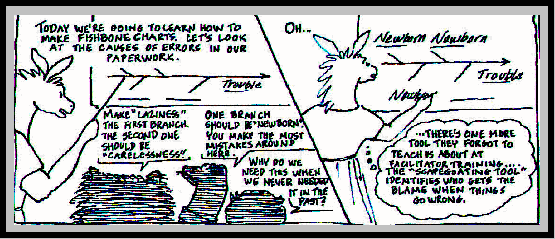
NEWBORN'S LESSONS IN HOW TO KILL TEAMS:
"What happens when team members choose to resist change?"
CHAPTER FIVE REVIEW
1. A key consequence of a team having argue-and-defend values is. . . ./font>
A. that the "truth" will get out because teams will divide into "us" versus "them"
opposing sides.
B. that no topic will be undiscussable since opposing sides will make sure every
weakness of the other side is exposed.
C. that the team will find it easy to talk about trivial issues, but afraid to talk about
controversial issues. 2. Ground rules should be developed by. . . .
A. whoever creates a team in the first place.
B. the team itself. All rules should be selected by consensus.
C. the Steering Committee for the organization. Ground rules should be the same for
every team operating in the organization. 3. A quorum of 2/3 would mean. . . .
A. that a super-majority of 2/3 is needed in order to win a vote.
B. that 2/3 of the team members must be present in order to hold a meeting.
C. that 2/3 of the team members can call a meeting even if the team leader and
facilitator refuse to hold the meeting. ANSWERS
1. "C" is correct. Because of the arguing, people will attempt to avoid discussing
openly any topic that is controversial. Instead, they will talk behind one another's
backs, and say things about other people that they won't say directly to the person.
2. "B" is correct. Some organizations attempt "C" in the name of standardization.
This is a mistake. Teams must live with their own rules. Standardization will
gradually come about as teams share ideas with another that seem to work.
3. "C" is the correct answer. Quorum's range from 100% to 50% and include special
requirements like "At least one union steward must be present."
CHAPTER 1. How often should a team have continuous improvement and feedback?
A. Roughly five minutes for every hour of meeting time. For a two hour meeting,
that means the last ten minutes is reserved for improvement.
B. Roughly five minutes per meeting regardless of length of meeting.
C. Only when the team feels the need for it. It is a waste of time to get feedback
from every meeting.
2. When some team members seem to have hidden agendas, the facilitator
should. . . .
A. ignore the issue and hope it goes away.
B. Confront the individuals and ask, "What's your hidden agenda? What are you
attempting to get here?"
C. Return to the Team Charter and review the purpose of the team and how it is
supposed to measure success.
3. When a team member notices that the team is not following its agenda, the
team member should. . . .
A. wait until the end of the meeting and bring it up during feedback. This is
because it is the facilitator's job to watch the agenda.
B. immediately raise his or her hand and point out to the facilitator that the
agenda is not being followed.
C. not do anything. This is the job of the facilitator and team leader. Team
members can complain that agendas were not followed, but have no responsibility
to see to it that the agendas are followed.
ANSWERS
1. "A" is the answer. When meeting for eight hours, then every two hours, there
should be discussion about how to improve the meetings.
2. "C" is correct. The facilitator should bring up the charter by saying something
like, "I sense that we are not all going in the same direction. I want to review the
Charter just to make sure we are all on the same wave length." There is no reason
to be confrontive over this.
3. "B" is correct. All team members are co-facilitators. That means when ground
rules are broken or agendas are not followed, they have a responsibility to
immediately speak up. This includes bringing up conflict that the team may not be
openly addressing.
Chapter One Chapter Two
Chapter Three
Chapter Four
Chapter Five
Chapter Six References and Copying Rights 
Top of Page.
Home Page
Sounding Board
Books
"The Facilitator Toolbox"